

Delta DL139 Venice to Atlanta Diverted to Amsterdam: Complete Incident Explanation
The majority of long-haul flights from Venice to Atlanta have a predictable schedule. Everything seems to be stable. The lights go down, the passengers settle in, and the plane begins its transatlantic journey. But on Delta Flight DL139, something changed mid-air quietly.
It wasn’t dramatic at first. No alarms in the cabin, no visible panic.
Just a cockpit alert that required the crew to pause, assess, and make a decision that would shift the entire journey.
Instead of continuing across the Atlantic, the plane turned toward Amsterdam Schiphol Airport, showing no signs of panic. It was simply a cockpit alert that prompted the crew to pause, evaluate, and decide on a course that would alter the entire journey.
In this breakdown by The Travel Hub Dubai, we explore what likely happened on the DL139 Venice to Atlanta diversion to Amsterdam and how these situations are handled in real-world aviation.
Flight Overview: Delta DL139
Italy and the United States are connected by the long-haul international Delta (DL139) route from Venice to Atlanta.
Key details:
- Route: Venice (VCE) → Atlanta (ATL)
- Airline: Delta Air Lines
- Aircraft: Wide-body jet (commonly Airbus A330 or Boeing 767, depending on schedule)
- Diversion airport: Amsterdam Schiphol (AMS)
- Planned duration: Around 10–11 hours
These aircraft are built for long ocean crossings. They operate with multiple backup systems, which means even small alerts are taken seriously when flying far from land.

What Likely Triggered the Diversion
Early reports usually mention a “technical issue,” but in aviation, that phrase can mean several different things.
In situations like the Delta DL139 Venice Atlanta diversion Amsterdam, it often refers to precautionary alerts such as
- Minor changes in cabin pressure
- Readings of engine performance that are not typical
- Advisories for electrical systems
- Warnings about hydraulic systems
- Inconsistencies in the sensor or false alarms
Modern aircraft constantly monitor themselves. A single unusual reading doesn’t mean danger, but it does require attention. And in long-haul flight operations, attention often turns into action.
Most of these cases end up being non-critical. Still, procedure comes first.
Why the Pilots Decided to Divert
Once the alert appeared, the crew didn’t rush. They followed a structured process.
They checked:
- The state of aircraft systems
- Fuel remaining
- Future weather conditions
- Accessible airports in the area
The key factor here is geography. Over the Atlantic, options are limited. Once you move deeper into oceanic airspace, turning back or finding a nearby airport becomes more complicated.
That’s why aviation has a simple rule:
If something feels uncertain early, land at the nearest safe airport.
Amsterdam made sense for that reason. It wasn’t about urgency; it was about control.
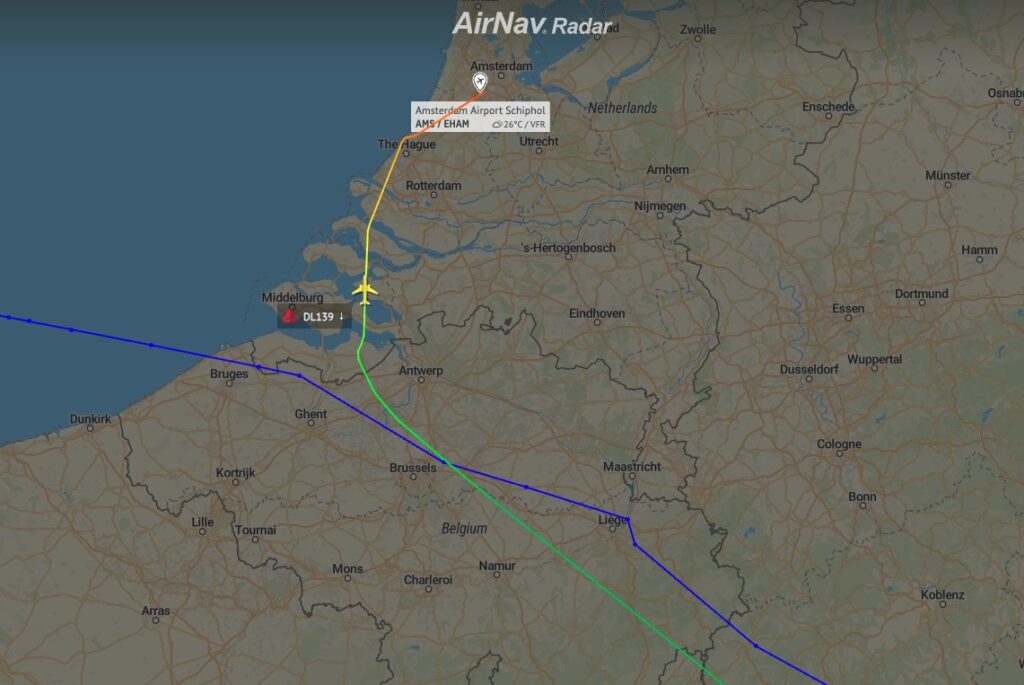
Source Image: Air Live
Not Just Pilots: The Ground Team Is Involved
A detail many people miss is that pilots don’t make these decisions alone.
Delta’s Operations Control Center monitors every long-haul flight in real time.
They work alongside:
- flight crew in the air
- engineering teams on the ground
- air traffic control units
So when the decision to divert was made, it was supported from multiple sides. It’s not a single judgment; it’s a coordinated safety network.
Why Amsterdam Was the Smart Choice
Amsterdam Schiphol is one of Europe’s most reliable diversion airports for long-haul flights.
It offers:
- strong maintenance support for wide-body aircraft
- long, international-grade runways
- fast passenger handling systems
- strategic location between Europe and Atlantic routes
For airlines like Delta, it’s a familiar and efficient option. When something unexpected happens mid-Atlantic, airports like Amsterdam quietly become the safest landing point available.
Inside the Cabin During the Diversion
For passengers, situations like this don’t usually feel chaotic.
At first, everything continues normally. Then small signs appear:
- slight changes in cabin activity
- updates on screens showing a new route
- a calm announcement from the cockpit
Most passengers are not told technical details, and that’s intentional. It helps keep the cabin calm while procedures continue in the background. From a passenger’s perspective, it often feels like nothing serious is happening… until the descent begins toward a different city.
What Happens After Landing in Amsterdam
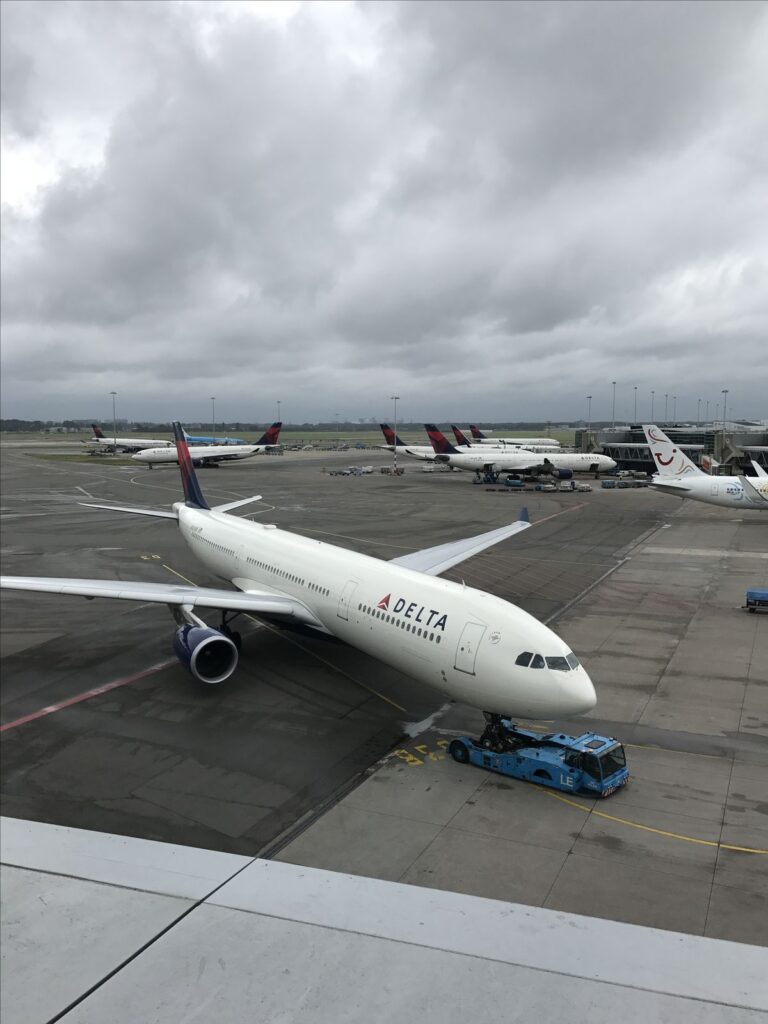
The ground crew takes over after the plane lands safely at Schiphol.
Engineers start checking right away:
- Diagnostics for systems
- Cockpit data analysis
- technical examinations
Next, a choice is made:
- Either the plane is promptly cleared
- It is still grounded for more inspections.
Typically, passengers are rebooked and sent on different flights to Atlanta.
Timing is never more important than safety, though delays may occur.
How Often Do These Diversions Occur?
Although incidents like the DL139 Venice to Atlanta diversion Amsterdam may seem strange, they are a common occurrence in aviation.
Long-haul diversions typically occur because:
- Early anomalies are detected by systems
- False warnings are produced by sensors.
- Protocols for precaution are triggered.
Above all, these diversions are not emergencies. These are preemptive measures implemented early on to prevent escalation. A diversion is not a failure, to put it simply. The system is operating as it was designed to.
The Truth About This Flight
In the grand scheme of things, this incident illustrates how contemporary aviation truly operates.
A few salient facts are as follows:
- The sensitivity of aircraft systems is very high.
- Instead of responding late, pilots are trained to act quickly.
- Teams for ground control assist with operations.
- In international aviation, major airports like Amsterdam play a vital safety role.
What seems to be a disruption turns out to be a controlled decision after a brief examination.
Aviation safety is proactive rather than reactive.
When Safety Changes the Destination
The Delta DL139 Venice to Atlanta diversion to Amsterdam is a reminder that aviation doesn’t wait for problems to grow; it responds at the first sign of uncertainty.
While passengers may see a sudden change in destination, the system behind it is carefully designed to protect every stage of the journey.
In this case, Amsterdam wasn’t just an alternate airport. It was the safest available decision at that moment.
At The Travel Hub Dubai, we aim to simplify real aviation stories so travelers understand what truly happens behind the scenes of air travel.
Because in aviation, the destination may change, but safety never does.
FAQ
- Why did Delta DL139 go to Amsterdam instead of Atlanta?
The plane got a small technical warning, so the pilot chose to land in Amsterdam for safety checks.
- Was there any danger on the flight?
No. There was no emergency. It was a safety precaution to make sure everything was okay.
- What type of plane was flying this route?
Usually, a big long-distance plane like an Airbus A330 or Boeing 767 is used.
- Do flights often change their destination like this?
Not very often. It happens sometimes, but most of the time it is just for safety, not because of danger.
- Why do planes land in Amsterdam during problems?
Amsterdam has a very big and well-equipped airport, so it is a safe place for quick checks and repairs.

Sarah Mitchell is passionate about discovering the best attractions and experiences across the United Arab Emirates. She writes about iconic landmarks, family-friendly destinations, beaches, museums, shopping districts, outdoor adventures, and hidden gems throughout the country. Her recommendations inspire readers to experience both world-famous attractions and authentic local experiences across every emirate.